ai
Enterprise AI Has Two Operating Models: Development Work and Knowledge Work
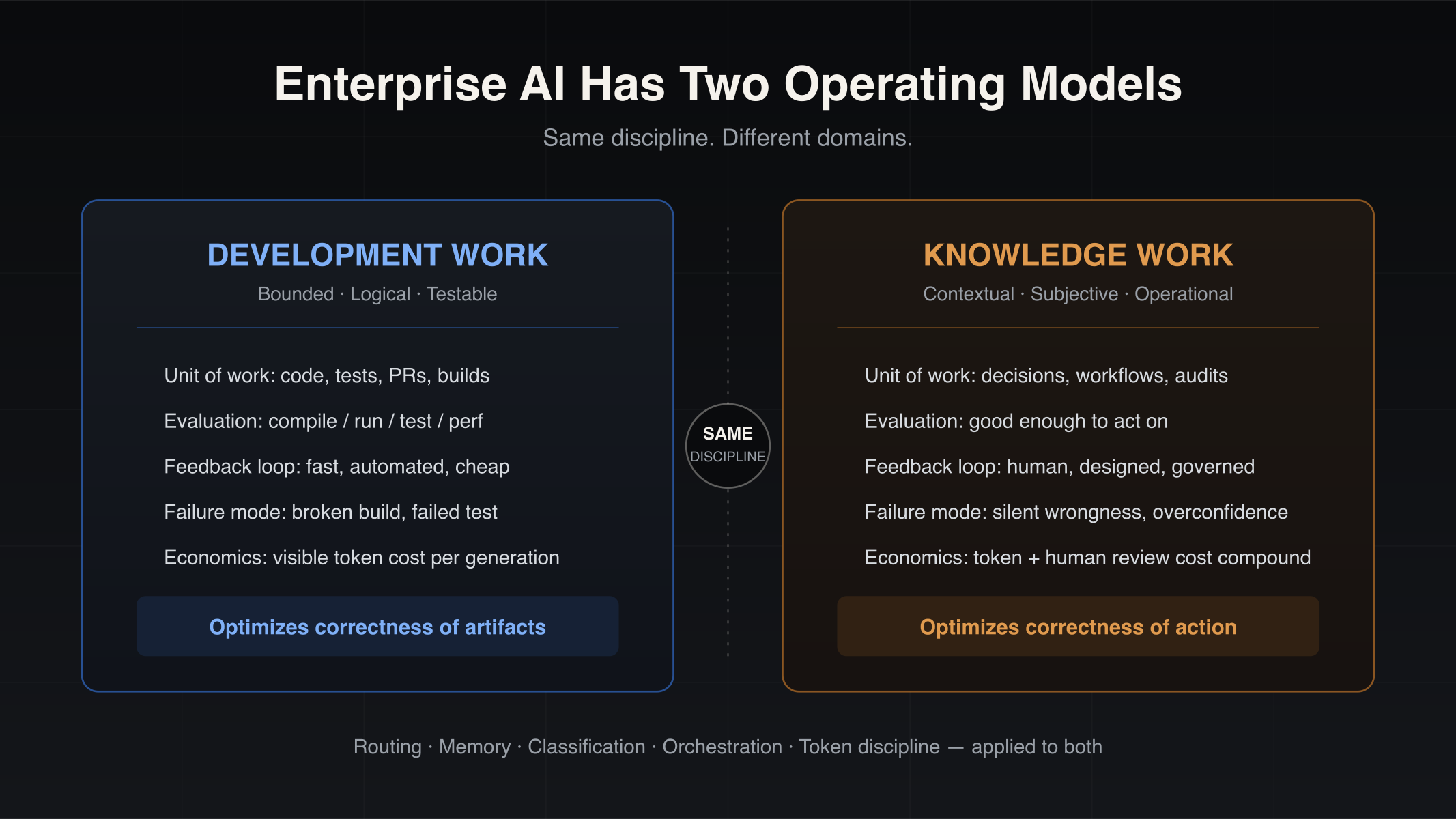
Enterprise AI is not one market. It is splitting into two operating models that look similar on a slide and behave nothing like each other in production.
One is development work. The other is knowledge work.
Confusing them might be why so many AI programs stall: teams copy the playbook that worked for coding copilots, drop it on operational workflows, and wonder why quality, cost, and adoption refuse to cooperate.
They are not two use cases. They are two systems of work — with different evaluation methods, different economics, and different paths to value.
Development work: bounded, logical, and testable
Development work is the clean room of enterprise AI.
A coding task is usually bounded. The problem space is logical. The artifact is self-contained. And the feedback loop is merciless in a good way: does it compile? Does it run? Does the test suite pass? Does performance hold under load?
That is why coding copilots gained adoption so quickly. You do not need a philosophy seminar to decide if the output is useful. You can measure it. Engineers can reject bad generations in seconds. Good ones ship. The organization learns because the evaluation function is almost free.
That is also why “AI for software engineering” felt inevitable. The unit of work already had acceptance criteria. AI did not invent quality for developers — it plugged into a quality system that already existed.
But the economics are catching up.
For a while, subsidized pricing made token spend feel like a rounding error. That era is ending. As list economics reassert themselves, development-side token consumption is becoming a material cost center: every autocomplete, every agent loop, every speculative generation shows up on a bill. The winners on the development side will not be the teams that generate the most tokens. They will be the teams that treat model selection, context packing, caching, and routing as engineering problems — because they are.
Development AI won first because it is measurable. It will stay valuable only if it stays cost-aware.
Knowledge work: contextual, subjective, and operational
Knowledge work is the rest of the enterprise: operational workflows, analysis, auditing, information handling, coordination, decision support, and the thousand half-finished tasks that keep a company moving.
Here, “did it run?” is the wrong question.
The real question is: is this good enough to act on?
That standard is contextual. It depends on the account, the policy, the risk tolerance, the timing, the unspoken politics of a deal, and the institutional memory living in people’s heads — not in the ticket system. Quality is not a green checkmark. Quality is judgment under uncertainty.
That is why knowledge-work AI is harder:
- Quality must be defined. “Helpful summary” is not a spec. Enterprises have to say what good looks like for each class of work: accuracy thresholds, citation requirements, approval gates, tone, completeness, and what must never be invented.
- AI must sit inside the workflow. A chatbot on the side of the desk is theater. Value appears when the system is embedded in how work actually moves — handoffs, reviews, escalations, CRM updates, customer commitments.
- Governance is not optional. Who can see which context? What gets logged? What requires human sign-off? How do you prevent quiet drift from “assist” to “act”?
- ROI is distributed. The return rarely shows up as one heroic automation. It shows up as fewer dropped balls, faster cycle times, cleaner handoffs, better-prepared meetings, and decisions made with the right facts in the room. Proving that requires operational instrumentation, not a demo reel.
If development AI is a compiler loop, knowledge-work AI is a management system. One optimizes for correctness of artifacts. The other optimizes for correctness of action.
Two operating models — not two features
Treat these as separate AI operating models and the org chart starts to make sense.
| Dimension | Development work | Knowledge work |
|---|---|---|
| Unit of work | Code, tests, PRs, builds | Decisions, workflows, communications, audits |
| Evaluation | Compile / run / test / perf | Good enough to act on |
| Feedback loop | Fast, automated, cheap | Slow, human, expensive unless designed |
| Failure mode | Broken build, failed test | Silent wrongness, overconfidence, process bypass |
| Economics | Token cost per generation becomes visible | Token cost and human review cost compound |
| Adoption path | Individual productivity → team standards | Workflow redesign → governance → measured outcomes |
You can buy a coding copilot and get value with relatively light process change. You cannot buy “enterprise knowledge AI” the same way. The product has to carry evaluation, memory, permissions, and orchestration — or the humans will reintroduce all of that as spreadsheet chaos.
What transfers from development AI to knowledge work
The good news: the discipline of AI engineering does transfer. The patterns that made development-side systems reliable and economical are exactly what knowledge work needs — applied to messier inputs and softer success criteria.
1. Intelligent model routing by task
Not every step needs the largest model. Classification, extraction, drafting, critique, and escalation are different jobs. Route deliberately: cheap and fast where the task is narrow; heavier models where judgment density is high. In Hive, model routing is already part of the agentic harness — because cost and quality are design constraints, not afterthoughts.
2. Durable memory and organizational context
A coding agent without repo context is useless. A knowledge agent without account history, prior decisions, open tasks, and relationship context is theater. Memory has to be durable, permissioned, and operational — not a chat window that forgets Monday by Thursday.
3. Classification
Before you generate, decide what kind of work this is. Intent classification, risk classification, entity resolution, priority — these are the boring layers that keep agents from improvising in the wrong register. Development systems learned this early with linters, type systems, and CI gates. Knowledge systems need equivalent structure.
4. Agentic orchestration and harnesses
The model is not the product. The harness is: planning, tool use, verification steps, human-in-the-loop checkpoints, retries, and audit trails. Coding agents improved when the loop around the model got serious. Knowledge-work agents will improve the same way — by treating orchestration as infrastructure.
5. Token optimization
Prompt bloat is not strategy. Retrieve what matters. Compress what does not. Cache stable context. Avoid multi-agent fan-out that re-reads the same world five times. As AI pricing normalizes, token discipline becomes a competitive advantage on both sides of the split — especially in knowledge work, where workflows run continuously rather than only when a developer is typing.
These are not “AI features.” They are operating-system concerns for enterprise intelligence.
Hive: engineering rigor for knowledge work
Hive is not “another AI tool” bolted onto the side of email.
Hive is the application of this engineering rigor — routing, memory, classification, orchestration, and cost-aware model selection — to the broader, messier world of knowledge work: the real workflows executives and operators live in every day.
Development AI proved that measurable systems win. Knowledge-work AI is harder because quality is contextual and ROI is distributed. It is also where most enterprise value actually sits: the decisions, follow-through, and institutional coordination that no green unit test will ever capture.
The winners will not be the companies that generate the most text. They will be the companies that run AI like an engineered system — on real human work, with real evaluation, real governance, and real economics.
Explore the operating model
If your organization is past the demo stage and ready to operationalize AI on enterprise knowledge and workflows — not just code — explore how Hive puts this operating model to work.
Development AI won first because it is measurable.
Knowledge-work AI is harder. It is also the larger enterprise opportunity.
The discipline is the same. The domain is not.
Rohit Garewal is the CEO of Object Edge, an AI-native professional services firm. Object Edge builds Hive, a semantic intelligence platform that helps enterprise organizations operate with AI at their core.
Related articles
-
ai
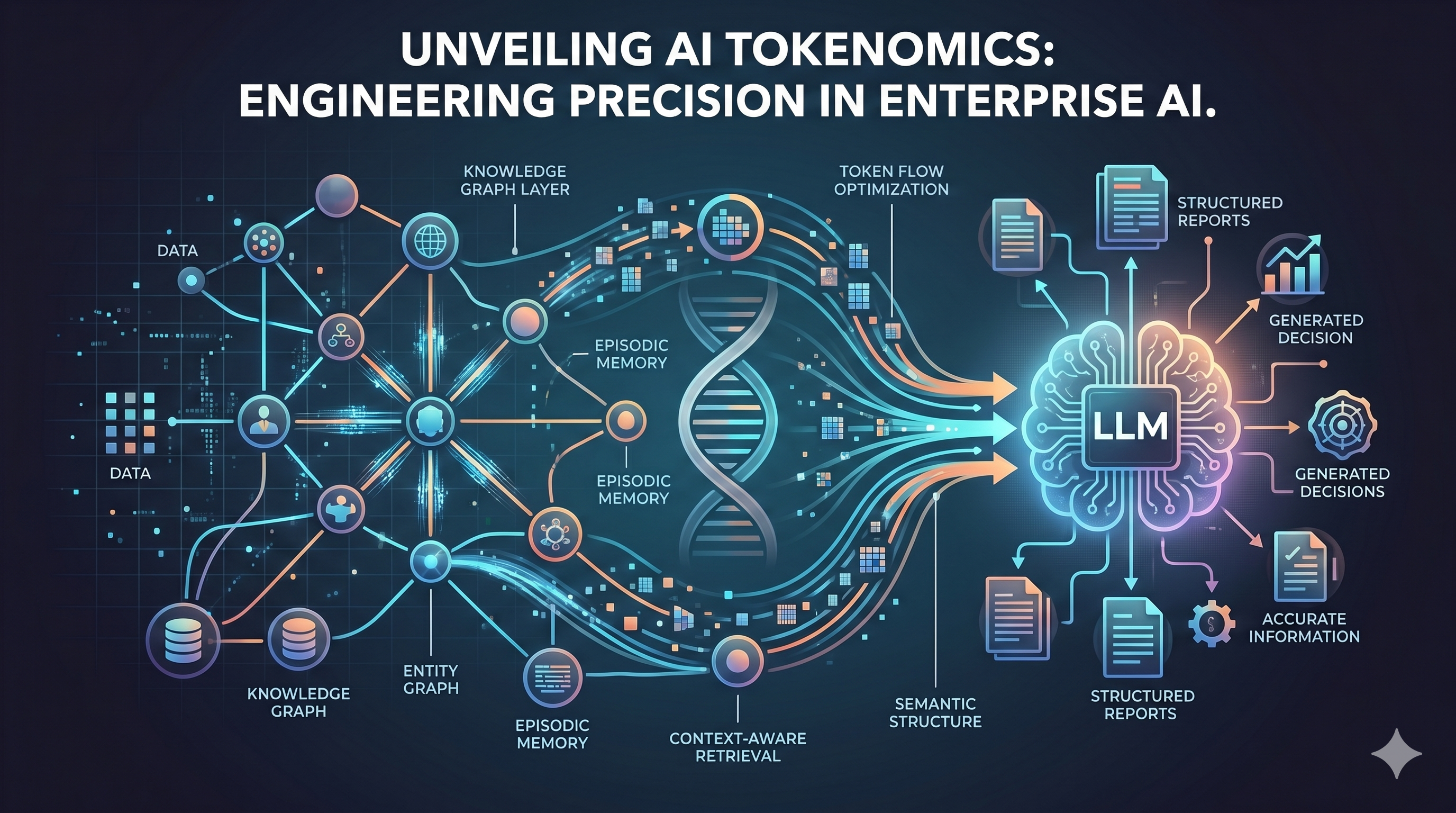
Tokenomics Is the New AI Efficiency Frontier — and Here's How We're Winning It
AI tokenomics is the discipline of managing token consumption at enterprise scale. Learn how semantic infrastructure, context-aware retrieval, and agent budgeting cut AI costs without sacrificing quality.
-
ai
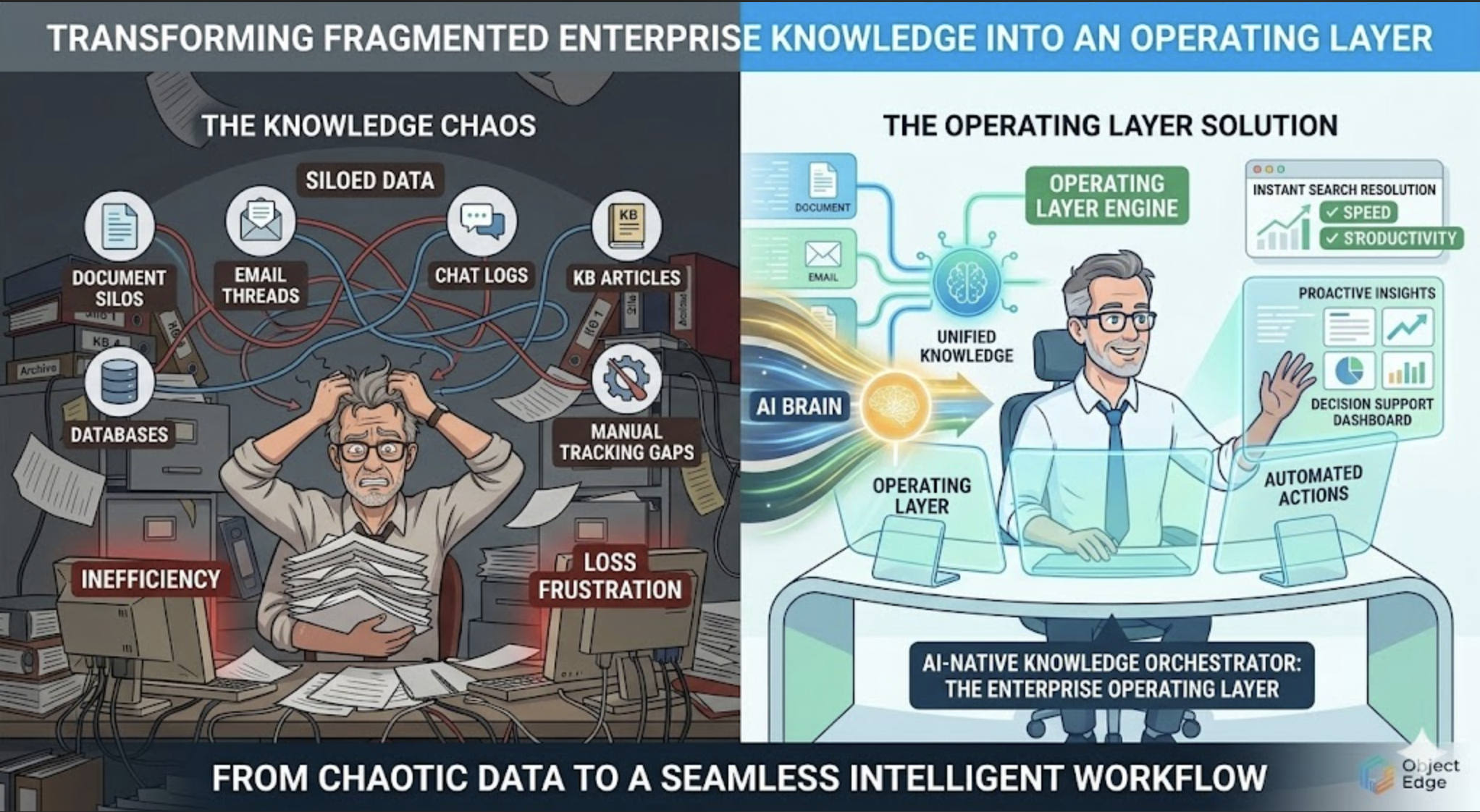
Turn Fragmented Enterprise Knowledge Into an Operating Layer That Teams Can Actually Use
How enterprises unify scattered documents, systems, and tribal knowledge into a searchable, governed operating layer that improves speed, consistency, and decision-making.
-
ai
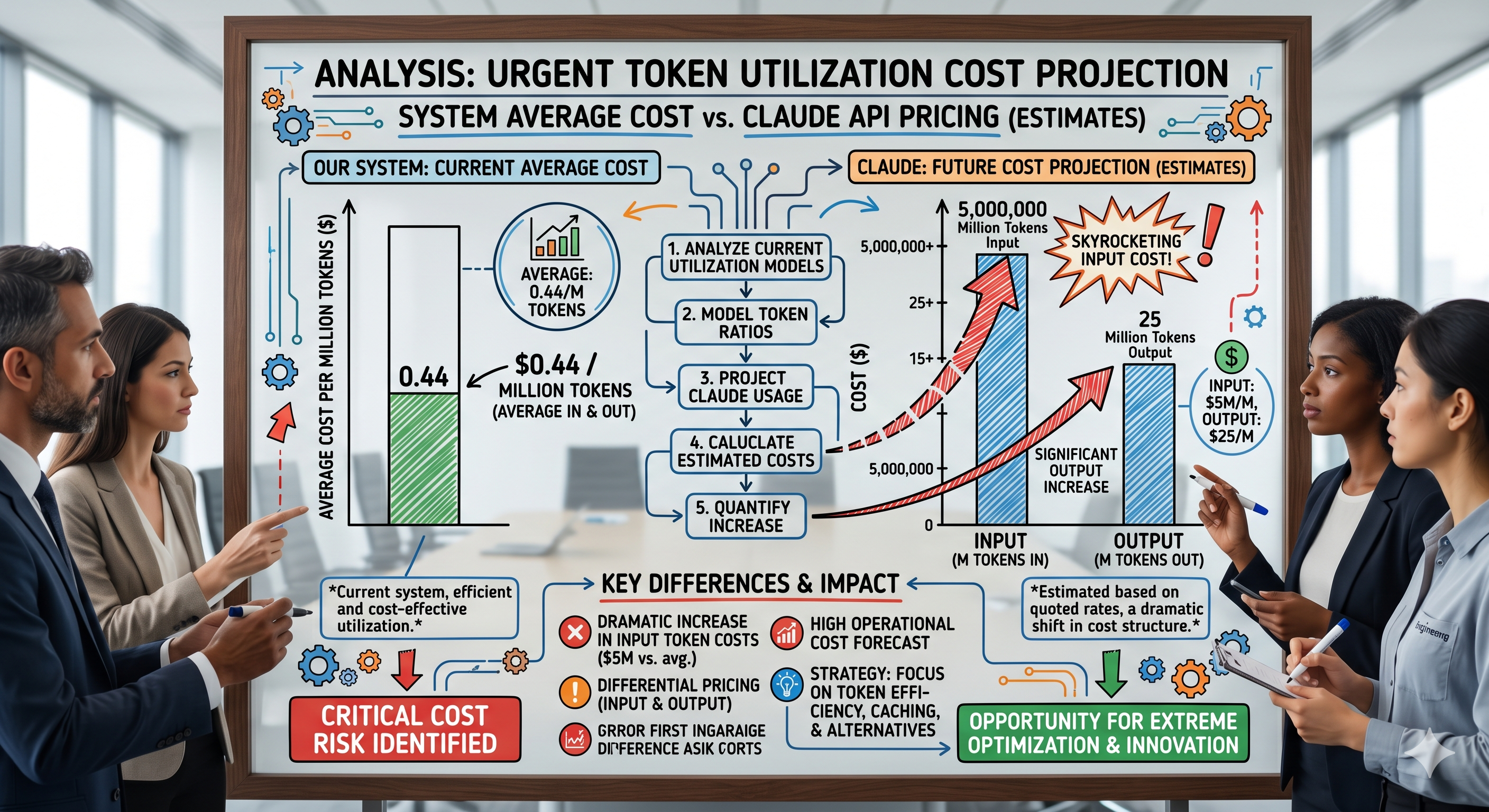
The End of Subsidized Tokens Is Coming. Plan Accordingly.
The era of artificially cheap AI tokens is ending. Here is why token efficiency is becoming architecture, and how enterprises should plan a model portfolio strategy before prices spike.